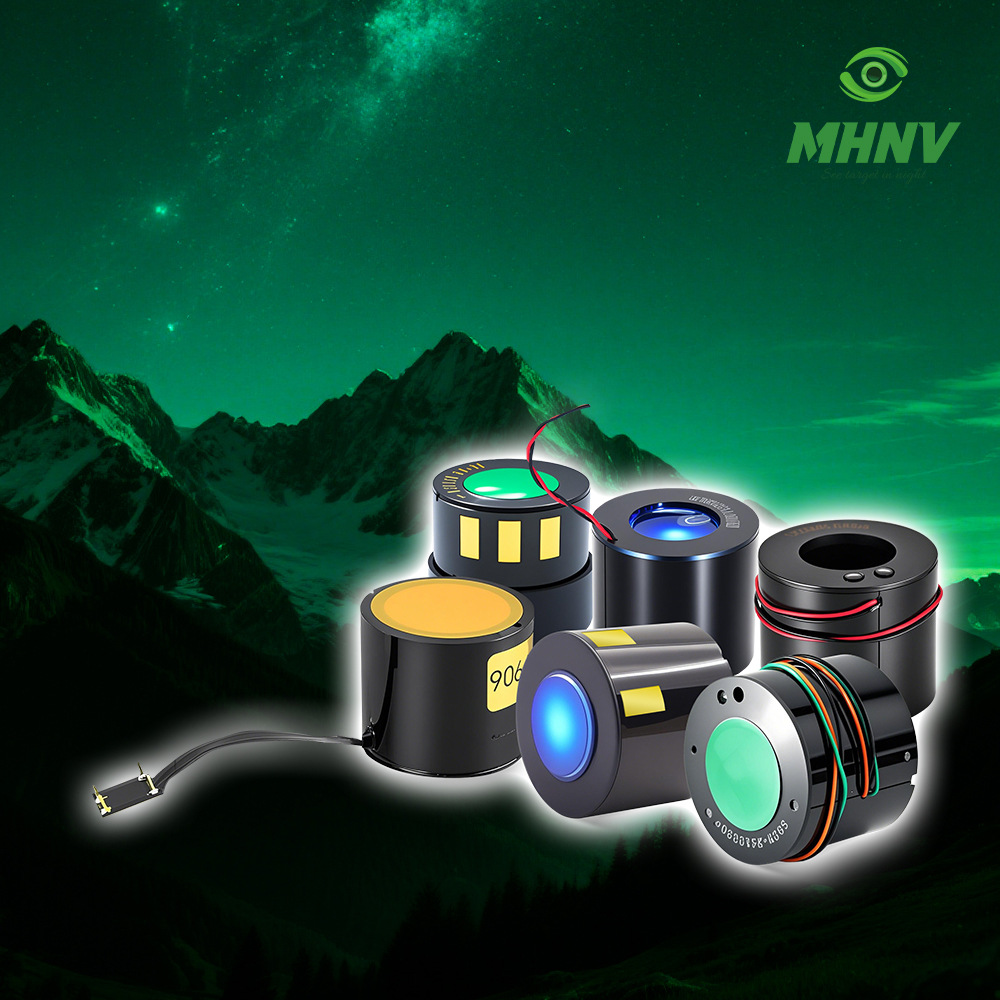
Among image intensifier tubes (IITs), Gen2+ (Super Gen2) and Gen3 are the two most frequently compared products in the night vision industry. Many customers wonder: both can amplify low-light images for night vision, so why are Gen3 tubes positioned at a higher tier with remarkable performance gaps?
The core distinction: Gen2+ is an improved version of Gen2 with multi-alkali photocathode. Gen3 adopts GaAs negative electron affinity photocathode, representing a fundamental upgrade in material technology. This material difference creates major gaps in near-infrared sensitivity, signal-to-noise ratio, recognition capability under ultra-low light, service life and other key parameters.
1. Two Distinct Technical Routes
Gen2+
Gen2+ still uses the classic multi-alkali photocathode (Sb-Na-K-Cs) from Gen2. Its optimizations focus on photocathode formulation, MCP microchannel plate manufacturing, noise reduction and component consistency.
It can be regarded as an enhanced Gen2 tube. It delivers stable imaging under moonlight, urban ambient light and short-range observation, with outstanding cost performance. However, limited by the inherent spectral response of multi-alkali material, its ability to capture near-infrared photons is weak, and it hits a performance ceiling in extremely dark environments.
Gen3
The biggest breakthrough of Gen3 tubes is the adoption of GaAs negative electron affinity photocathode, paired with an ion-barrier film MCP.
This is not minor tuning but a full upgrade of material system. GaAs photocathode efficiently captures abundant near-infrared photons in starlight (700–900nm). It delivers dominant imaging performance in moonless nights, dense woodland shadows and long-range reconnaissance with ultra-low illumination.
2. Core Improvements of Gen3 Compared with Gen2+
Higher Near-Infrared Sensitivity & Better Starlight Utilization This is Gen3’s most important advantage. Natural starlight contains large amounts of near-infrared light. Gen2+ is mainly sensitive to visible light, while GaAs photocathode of Gen3 multiplies the response to near-infrared spectrum.
The darker the environment, the greater Gen3’s advantage. The imaging difference narrows under moonlight or city glow. Gen3 shows superior recognition performance in moonless wilderness and heavy vegetation occlusion.
Higher SNR for Cleaner Dark Details Gen3 features higher signal-to-noise ratio, less grain noise and richer shadow layers. Under ultra-low light, Gen2+ produces heavy noise that obscures low-contrast targets. Gen3 retains target outlines and fine textures in dark backgrounds.
Simply put: Gen2+ brightens the image; Gen3 lets you see details in darkness.
Lower EBI for Deeper Black Background EBI (Equivalent Background Illuminance) measures inherent background brightness when no light enters the tube. Lower EBI means better performance. Gen3 achieves lower EBI with less haze and higher target contrast. Gen2+ tends to show grey background and lost shadow details in extreme darkness.
Higher Brightness Gain for Longer Observation Range Typical brightness gain of Gen3 exceeds Gen2+. It generates clearer usable output under faint input light. The gain advantage directly improves target identification distance for long-range low-light reconnaissance.
Better Halo Suppression Against Bright Point Sources When exposed to flashlights, vehicle headlights and other point light sources, Gen3 generates smaller halo and preserves details around bright sources. Gen2+ easily forms wide white fog halo, covering nearby objects.
Longer Service Life The GaAs photocathode and ion-barrier film reduce ion bombardment damage to the cathode, extending tube lifetime.
Gen2+: approx. 8000 hours; Gen3: 10000–12000 hours. Actual service life depends on operation intensity, strong light exposure and storage conditions.
3. Understand FOM (Figure of Merit)
FOM is a comprehensive performance metric for image intensifier tubes: FOM = SNR × Resolution (lp/mm) Higher FOM means stronger overall low-light detection & identification performance.
Gen2+: FOM 1400~1800
Gen3: FOM 1800~2800+
Note: FOM values cannot be directly compared across different manufacturers. To evaluate tube quality, check SNR, resolution, EBI, infrared sensitivity, halo performance and manufacturer test standards together.
4. Selection Guide
Choose Gen2+ if:
Operating environment: moonlight, urban low light, suburban areas
Medium observation distance, limited budget
Mainly for training, routine patrol and short-range observation
Choose Gen3 if:
Frequently used in moonless nights, dense forests and remote wilderness
Long-range target identification required
High requirements on dark details and low-contrast targets
Prioritize long-term stability and service life
5. Conclusion
The gap between Gen2+ and Gen3 is not merely "Gen3 produces brighter images". It is a generational gap brought by photocathode material upgrade.
Gen2+ relies on process optimization and provides cost-effective solutions for regular low-light scenarios. Gen3 with GaAs photocathode delivers stronger near-infrared response, higher SNR, lower EBI, better anti-halo performance and longer lifespan, with overwhelming advantages in ultra-dark environments.
When purchasing night vision devices, do not judge only by the “Gen” label. Evaluate comprehensively based on working environment, observation distance, budget and full set of specifications.
Xi'an MH Electronic and TechnologyCo.,Ltdfocuses on infrared thermal imagers and low-light night vision devices, delivering premium full-customization solutions covering appearance, hardware, software and packaging.
We are committed to top-tier tailored services for global partners.
Kindly click our email address to send your inquiry for bespoke solutions.
 tel