Night vision technology has evolved tremendously over the past several decades. From early Generation 1 systems to today's high-performance Gen2+ and Gen3 image intensifier tubes, one question occasionally arises from engineers and enthusiasts alike:http://https://www.facebook.com/share/v/197RZvi91G/
Why are image intensifier tubes only available in green and white phosphorus, but not red?
Some users will said thatred may appear attractive. It is commonly associated with preserving night adaptation in cockpit lighting and military displays. However, when it comes to image intensifiers, the answer involves much deeper considerations in optics, human physiology, phosphor science, and system engineering.
An image intensifier tube converts extremely weak incoming light into a visible image through three primary stages:
A photocathode converts photons into electrons.
The Microchannel Plate (MCP) multiplies these electrons thousands of times.
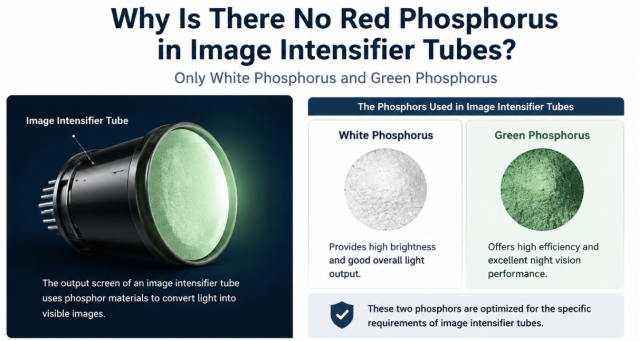
The phosphor screen converts the amplified electron image back into visible light.
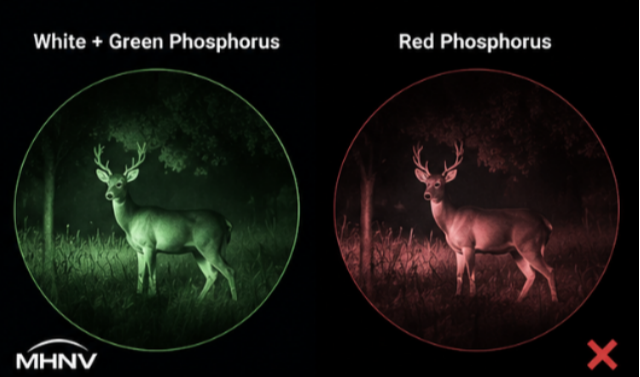
The phosphor screen determines the color that the user ultimately sees.
Historically, two phosphor types dominate the industry:
P43 Green Phosphor
P45 White Phosphor
Both have been optimized through decades of military research and operational experience.
Human Eyes Are Most Sensitive to Green
The primary reason green phosphor became the military standard is rooted in human visual physiology.
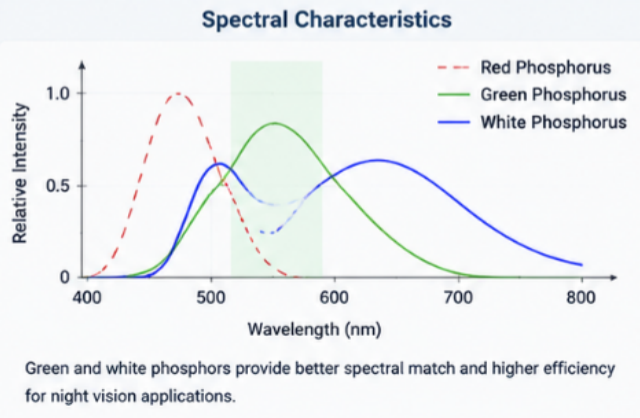
Under low-light conditions, the human eye relies heavily on rod cells. These cells are most sensitive to wavelengths around 507 nm, which falls within the green region of the visible spectrum.
Because of this:
Green images appear brighter at the same output energy.
More image detail can be distinguished.
Less electrical power is required to achieve a usable image.
Operator fatigue is reduced during prolonged observation.
Simply put, green phosphor provides the highest visual efficiency for night vision applications.
Modern white phosphor tubes were introduced to improve perceived image quality rather than increase sensitivity.
Instead of producing a monochromatic green image, white phosphor generates grayscale images with improved contrast perception.
Many experienced users report that white phosphor:
Feels more natural.
Makes object recognition easier.
Reduces mental fatigue during long missions.
Improves target discrimination in complex environments.
Importantly, white phosphor still emits a broad spectrum that includes wavelengths to which the human eye remains highly sensitive.
Why Red PhosphorOr Another ColorIs Not Used
Although red illumination is commonly used in aviation cockpits and tactical equipment to preserve dark adaptation, image intensifiers have entirely different performance requirements.
Several technical challenges limit the practicality of red phosphor.
1. Lower Visual Sensitivity
Human rod cells have very poor sensitivity to deep red wavelengths.
To produce an image with equivalent perceived brightness, a red phosphor screen would require significantly higher luminance output.
This increases power consumption while reducing overall system efficiency.
2. Reduced Image Resolution
Image intensifiers are designed for recognizing extremely fine details under near-total darkness.
Because the eye perceives less contrast in red under scotopic conditions, a red display would make subtle textures and small objects more difficult to distinguish.
Overall recognition performance would decline.
3. Phosphor Material Optimization
Military phosphors such as P43 and P45 have undergone decades of optimization for:
Brightness
Persistence
Grain structure
Electron conversion efficiency
Lifetime stability
Developing a high-performance red phosphor would require extensive redesign and qualification.
There is currently little operational demand to justify such investment.
4. Military Standardization
Night vision equipment used worldwide follows long-established military specifications.
Training procedures, maintenance protocols, optical calibration, and user familiarity have all been built around green and white phosphor technologies.
Introducing an entirely new phosphor color would require substantial testing and recertification without offering significant operational advantages.
Could Red Phosphor Be Manufactured?
From a purely scientific perspective, the answer is yes.
A red phosphor screen can be fabricated using suitable phosphor compounds.
However, manufacturing a laboratory sample is fundamentally different from producing a high-performance image intensifier suitable for military or professional applications.
Such a tube would require:
New phosphor deposition processes
Electron-beam optimization
Lifetime verification
Environmental qualification
Extensive optical characterization
The engineering cost would be extremely high while market demand remains extremely limited.
For this reason, no major image intensifier manufacturer currently offers red phosphor tubes as a standard commercial product.
Engineering Focus Matters More Than Color
In practical applications, image quality depends far more on factors such as:
Signal-to-noise ratio (SNR)
Resolution
Photocathode sensitivity
Halo performance
Figure of Merit (FOM)
Automatic gain control
Auto-gating technology
These parameters have a much greater impact on operational performance than phosphor color alone.
At Xi'an MH Electronics And Technology Co., Ltd.,we specialize in the development and manufacturing of advanced night vision technologiesand complete electro-optical systems.
Our product portfolio includes:
Gen2+ Gen3 image intensifier tubes
High-FOM: FOM1400/1600/1800/2000+
White and green phosphor
Auto-gated and manual gain function
PVS14 night vision monocular, PVS31 night vision binoculars, PVS7 night vision goggles, GPNVG.
Thermal imaging devices: car camera, handheld and multi-functional thermal binoculars
Optical and electro-optical integration services
Rather than pursuing colors that offer little practical advantage, our engineering efforts focus on what truly improves operational performance—higher sensitivity, lower noise, better image stability, and greater reliability in demanding environments.
Xi'an MH Electronics And Technology Co., Ltd. is a professional manufacturer specializing in night vision technologies, thermal imaging systems, optical components, and customized electro-optical solutions for industrial, security, law enforcement, and defense applications. With strong R&D capabilities and strict quality control, MH is committed to providing reliable products and long-term technical support to customers worldwide.
 tel
tel